Pecunia

Budget better. Save more.

A money app for students in Canada. It finds what you’re overpaying, shows what’s safe to spend, and tells you what’s about to charge you.

Early access by invite. 1,990 people are waiting. Privacy

Private by design

  • Read-only, through Plaid
  • Hide every amount in one tap
  • Lock it with Face ID
  • Delete your account in the app

Your everyday money, sorted.

See what it does

Ways to save

Fees you pay for nothing.

Pecunia looks through your charges for fees, price rises and plans you pay twice for. Each comes with what it costs a year, and the words to get it back.

Ways to saveEach way to pay less that Pecunia found, with what it adds up to a year.
Ways to save: about 72 dollars a month across five ways.
A price that went upA subscription that costs more than it did: the rise a month, the rise a year, and its last charges.
A price that went up: a subscription rose by one dollar a month, 12 dollars a year, with its last five charges as bars.
Who owes youYour friends, what each one owes you, and who paid you back.
Who owes you: friends, what each owes, and who paid back.

Bills

Bills, before they’re due.

Pecunia finds the charges that repeat. It lists them soonest first and shows your lowest point before payday.

Bills and subscriptionsEvery charge that repeats in one list, soonest first, with the total a month.
Bills and subscriptions: 2,393 dollars a month across 17 bills, soonest first.
One bill, month by monthOne bill: its amount, the day it’s due, and each past payment as a bar.
One bill: rent of 1,848 dollars every month, due in four days, with each payment as a bar.
To payday and afterYour balance drawn forward: the lowest point before payday, then what lands and what leaves.
Cash flow: the lowest point before payday, then what lands and leaves after it.
Before paydayWhat’s safe to spend today, and which budgets it can come from.
Before payday: 1,135 dollars safe to spend today, and where it can go.

Budgets

Budgets on your pay.

Pecunia counts your budget from one pay to the next. You see what’s left before you tap.

This month, week by weekWhat you spent of the month’s budget, week by week, and where the month’s money comes from.
Budgets: 1,504 dollars of 3,459 spent in September, week by week, and where the month’s money comes from.
Safe to spend until paydayOne number: what you can spend before your next pay, with the bills ahead under it.
Budgets until payday: 12,490 dollars safe to spend, the bills ahead and each pay cycle as a bar.
One budget, day by dayOne budget’s pace as a line, what’s left in it, and each past month as a bar.
The housing budget: 7 dollars left in September, its pace as a line, and each month as a bar.
Pay to payYour spending from one pay to the next. Each pay cycle is a bar.
Pay to pay: 242 dollars spent this cycle so far, with each pay cycle as a bar.

Can I afford it?

Ask before you buy.

Type a price. Pecunia checks it against your budget and answers before you pay.

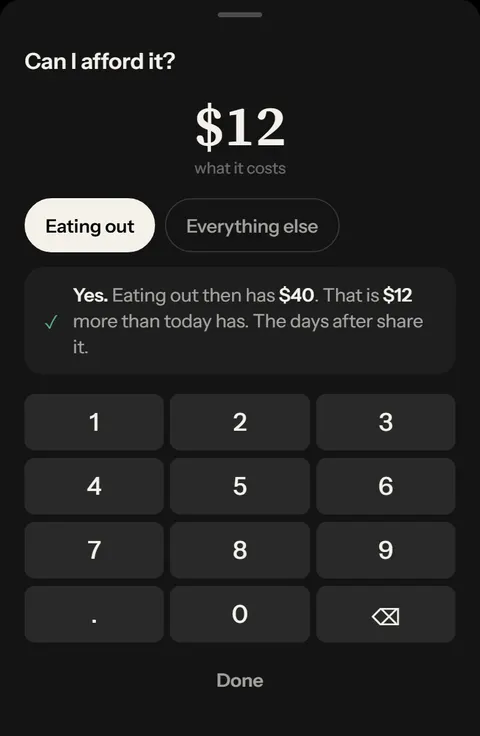
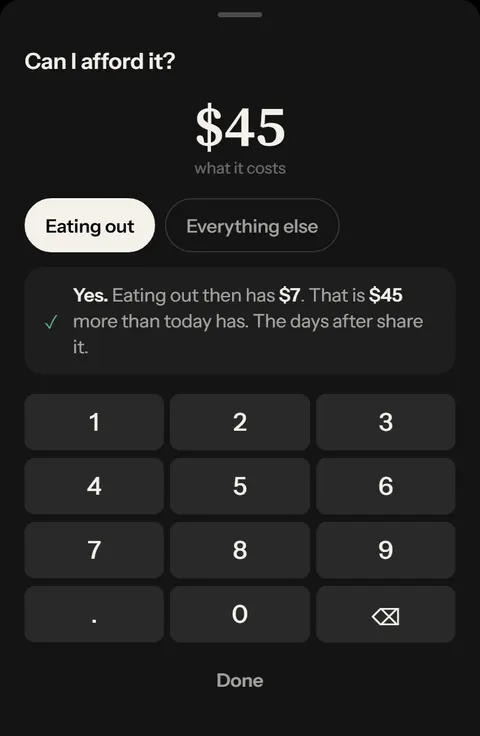
A price, typedEvery key changes the answer: yes or no, what the budget has after, and what it does to today.
Can I afford it, on the demo account. At 12 dollars and at 45 dollars the answer is yes, with what the Eating out budget then has. At 120 dollars it is no: the budget has 52 dollars and needs 68 more.

Spending

Where it went.

Pecunia sorts every charge into a category. You see the month as a ring and each day on a calendar.

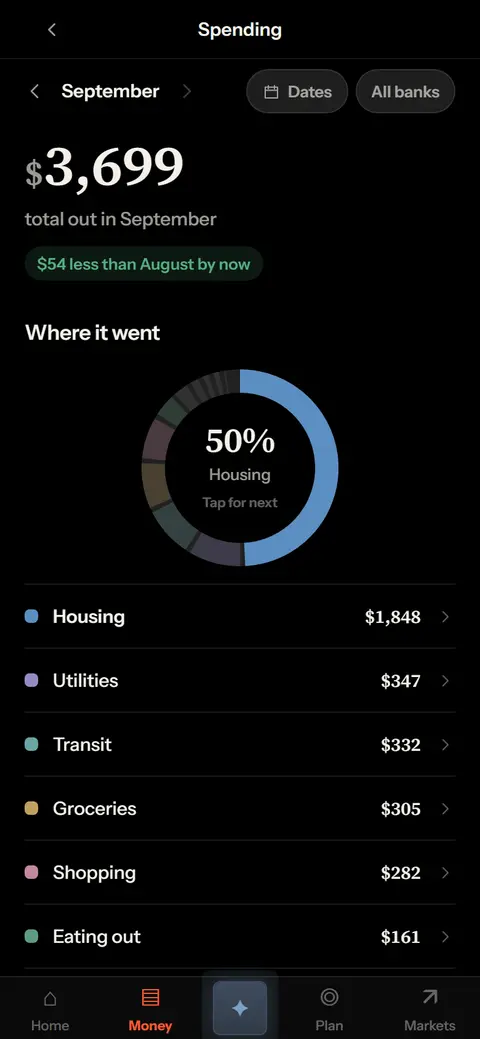
Where it wentYour month as one ring. Each slice is a category.
Spending: where September went, as a ring of categories.
Day by dayA calendar of the month. Each day shows what went out.
Day by day: a September calendar with what went out on each day.
Sorting a chargePecunia guesses the category and says why. One tap changes it, and a rule remembers.
Sort charges: a 960 dollar charge, Pecunia’s guess of Transfers, and a row of categories to pick from.
Money inWhat came in this month. Six months as bars, and each regular pay by name.
Money in: 6,106 dollars came in during September, with six months as bars and each regular pay.

Your habits

What a habit adds up to.

Pecunia adds up the places you go most. You see each stop and what a year of it costs.

Your habitsEating out, bars and fun over 90 days, added up place by place.
Your habits: 968 dollars on eating out, bars and fun in 90 days, place by place.
One placeOne place: every stop you made, by month and by day of the week.
One place: 52.50 dollars in 90 days over nine stops, by month and by day of the week.

Updates

What needs you, in one list.

Pecunia tells you when a budget goes over, a free trial is about to charge, or a stock crosses your price.

  • A free trial at Streamly may end soonFirst charge $1.00 on Sep 12.
  • Reading week trip is a quarter savedOf your $600 goal.
  • MSFT rose past your priceAbove your US$425.
  • A night outSat, Sep 26 · The Copper Fox · Over your usual
Over a budgetOne update, opened: how far over the budget is, and what you spent against it.
Fees: 40 dollars over budget this month, with 64.95 dollars spent against a 25 dollar budget as two bars.
A price alertSet a line on a stock or a coin. Pecunia tells you when the price crosses it.
A new price alert on one stock: a target of 240 US dollars, 12 dollars above today’s price.

Calendar

Your month ahead, on one calendar.

Pecunia puts your bills, your paydays and your own plans on one calendar. Tap a day to see what’s coming.

The monthEach bill sits on the day it’s due. Paydays and your own plans sit beside them.
Calendar: September, with each bill named on its day, two paydays and a birthday.
A day aheadAny day ahead: the bills due, the pay that lands, and about what’s left after.
Friday October 9: about 12,922 dollars left after, two bills coming, a payday of 431.75 dollars and an event.

Recaps

Your night out, replayed.

Pecunia puts a night out back in the order it happened. Every week gets its own recap too.

Saturday nightA night out, replayed stop by stop. Tap the button to play it again.
Saturday night was a night out: two places, four tabs, and a button to replay the night.
Your week, told backSix weeks of spending as bars. Each week and each night out opens its own recap.
Recaps: six weeks of spending as bars, then each week and night out.

Plan

Where you’re going.

Set a goal and list what you owe. Pecunia tracks both and gives your money one score.

Your goalsEach goal and how far along it is. You see, week by week, if it’s on track.
Your goals: a reading week trip on track, week by week.
One goalWhat you’ve put in, what’s left, and the amount a week that keeps it on track.
The reading week goal: 120 dollars of 600, 23 dollars a week keeps it on track, with each week as a bar.
Out of debtEverything you owe in one place, with what the interest costs a year.
Get out of debt: three debts and what the interest costs a year.
Your Pecunia ScoreOne score for your money, and the parts it adds up from.
Pecunia score: 66, fair, and how it adds up.

Net worth

What you own and owe.

Pecunia adds every account, card and debt into one number. It also shows what a card costs if you pay only the minimum.

Assets and debtsWhat you own minus what you owe, as one line, and what moved it this month.
Assets and debts: a net worth of 32,721 dollars as a line, what moved this month, and what you own.
A bank accountOne account’s balance as a line, with its latest activity under it.
A chequing account: 4,400 dollars, the balance as a line, and the latest activity.
A credit cardWhat you owe on one card against its limit, with the balance as a curve.
A credit card: 640 dollars owed of a 2,500 dollar limit, with the balance as a curve.
A card statementWhat the statement adds up to, the day it’s due, and what paying all of it or the minimum costs.
A card statement of 612.40 dollars: pay 35 by October 20, how it adds up, and what to pay.

Markets

Your portfolio and the markets.

Pecunia shows what your holdings are worth and how each one moved today. The wider market sits beside them.

Your portfolioWhat your holdings are worth today, and how each one moved.
Portfolio: 13,603 dollars, up 44 dollars today, with six holdings and how each moved.
MarketsThe market’s day: how many big companies rose, the S&P 500 as a line, and what moved most.
Discover: most big companies rose today, the S&P 500’s day as a line, and what moved most.
What moved your dayYour day’s gain or loss, split into one bar for each holding.
What moved your day: up 44 dollars, with one bar for each holding.
Names you watchThe names you follow, each with a small line of its price.
Watching: six names, each with a small price line.

The market

The market, in pictures.

Pecunia draws the day’s market. You see which companies, sectors and themes rose and which fell.

Moving mostCompanies that rose stand above the line. Companies that fell hang below it.
Moving most: the companies that rose stand above a line and the ones that fell hang below it.
SectorsA map of eleven sectors, coloured by how each moved today.
Sectors: a map of eleven sectors, coloured by the day’s move.
ThemesTen themes as circles. A bigger circle is a bigger move today.
Themes: ten themes as circles, bigger for a bigger move.
Earnings calendarA month of earnings and dividend dates for the names you hold.
Calendar: October, with earnings and dividend dates for names you hold.

Crypto

Crypto, beside your stocks.

Coin prices sit beside your stocks. Each coin has its own page, and the day is drawn as a race.

BitcoinOne coin’s page: its price over a month, what you hold on paper, and why it moved.
Bitcoin’s page: the price as a line over a month, a paper holding and why it moved.
The day’s raceFour coins start level. The lines show which moved most in 24 hours.
Crypto: four coins raced from one start over 24 hours, then a tile for each coin.

Paper trading

Trade with pretend money.

Pecunia gives you a pretend book to buy and sell in. Not real money. Past prices don’t say what comes next.

Your paper bookA pretend account with pretend dollars, marked not real money.
Paper trading: a pretend book of 10,185 dollars, marked not real money, with three names.
Back in timePick a company and a past day. See what 500 pretend dollars are worth today.
Back in time: 500 pretend dollars put into one company on a past day, and what they are worth today.
A stock’s pageOne company: its price as a line, the shares you hold, and why it moved.
A stock’s page: the price as a line, the shares you hold, a paper holding and why it moved.

Ask Pecunia

Just ask.

Ask in plain words. Pecunia adds up your own charges and answers with a figure. Computed, never guessed.

  • When’s rent?
  • Am I on track?
  • What’s due this week?
One question, one answerAsk “Where did my money go?” and the answer is your month, as a figure and a ring.
Ask Pecunia answers Where did my money go: 3,699 dollars spent in September, as a ring of categories.

Privacy

Hide every amount in one tap.

One tap turns your amounts to dots, on every page. Tap again and they’re back.
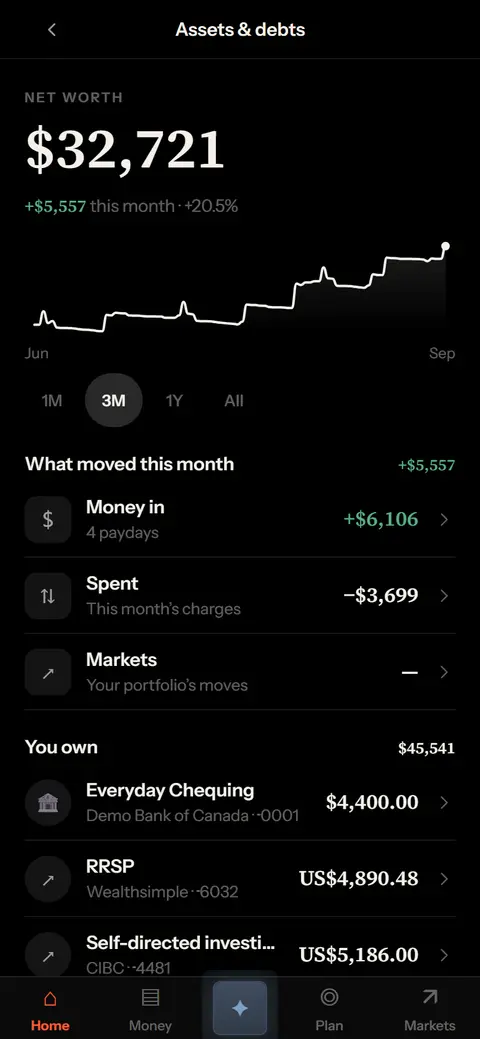
Net worthThe total, each account and each balance turn to dots. The line stays.
Assets and debts on the demo account, with every amount shown. The switch turns each amount to dots.
SpendingThe ring and the names stay. The amounts beside them turn to dots.
Spending on the demo account, with every amount shown. The switch turns each amount to dots.

It can’t move your money.

See Plaid’s security page
  • Read-only. It can see your accounts. It can’t pay, send or withdraw.
  • Pecunia never sees your bank password. You sign in through Plaid, which doesn’t share it with apps.
  • Plaid is audited. Its security page lists SOC 2 Type 2 and ISO 27001.

How it works.

  1. Join the waitlist

    Early access is by invite.

  2. Link your bank

    You sign in through Plaid. Pecunia never sees your password.

  3. Pecunia goes through it

    Read-only. It sorts each charge, finds your bills and looks for what you overpay.

  4. See what to do

    What’s safe to spend, what’s coming, and what you can stop paying for.

Questions.

What is Pecunia?

A money app for students in Canada. It goes through your bank accounts and finds where you can save.

How does it help me save?

It finds fees, plans you pay twice for and prices that went up. It shows what’s safe to spend before payday. What you do next is up to you.

Can it move my money?

No. It’s read-only, through Plaid.

Which banks work?

Banks that connect through Plaid. Brokerage-only firms don’t link.

What does it cost?

Prices start at launch. There is a free tier. Basic starts at $10.99 a month.

When can I get it?

Early access is by invite. Join the list and we’ll email you.

Budget better. Save more.

Early access by invite. 1,990 people are waiting.

Join the waitlist